Dr Jo Miller and Dr Stuart Eydmann
The speakers are Dr Jo Miller (Ethnomusicologist) and Dr Stuart Eydmann (Honorary Fellow University of Edinburgh).
The historical instrumental music of south-west Scotland is largely unexamined and under-researched possibly because of the dominance of musical culture in other areas – for example Shetland, the Orkneys or Highland Scotland. This talk will introduce current research on the lively local culture of fiddle music and dance in Dumfries and Galloway – its performers, composers, teachers and collectors.
There was an issue with the sound on this recording and the music was not recorded.
The music clips played for slide 4 (Portpatrick & Spedling Castle's Ghost) and slide 8 (Lochwood Mains Parlour) are available below the main recording of the meeting.
The 19th and early 20th centuries saw the development of an extremely diverse musical culture throughout Scotland: manufacture and marketing of instruments, publication of collections, leisure-time music making and educational uses of music, including in Dumfries and Galloway. This talk drew on a range of sources including local fiddle manuscripts, archives and press reports to explore this ‘hidden history’.
One example of a musical family extending over 150 years was the Crozier family who originated in Kirkcowan. John Crozier played in the Kirkcowan orchestra around 1900 and had his own dance band; his brother Tom moved to Dalry where he conducted the local choral society; his son David played the trumpet in a dance band, and his son, John, now leads fiddlers in the Strathspey and Reel Society in Stirling which held its most recent concert last month in Stirling.
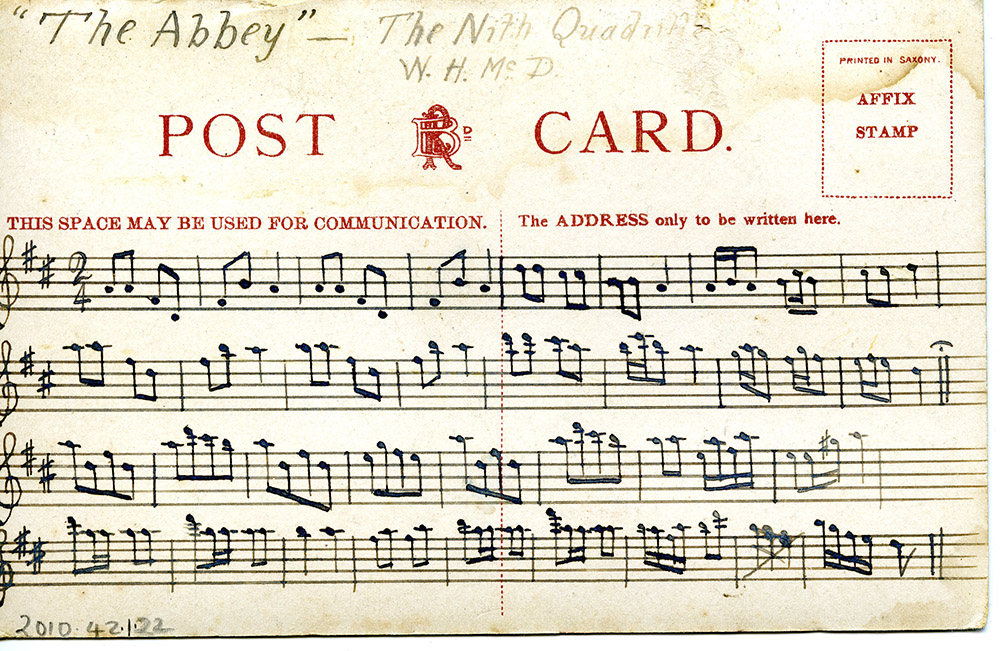
Four manuscripts of fiddle tunes were mentioned: firstly the James Hanning manuscript written c.1790-1820 in Gatehouse of Fleet which contains over 90 tunes; secondly the manuscript of John Galbraith from Dalmellington c.1836, which included part of Carsphairn. The third manuscript was that of William Dickson, based in Amisfield, made between the 1870s and up to the early decades of the 20th century which contained around 300 tunes. The last collection was that of Frank Gilruth made between 1882 and 1915 in the Dumfries area – and in Dumfries Museum there is a collection of around 900 postcards and on the back of each postcard Frank Gilruth had written a tune.
The repertoire of these four manuscripts consisted of a wide variety of tunes: strathspeys, reels and jigs, for example, many of which had local names - Portpatrick and the Old Spedlins Castle Ghost’s Dance. When this was played for the country dances, one of the dancers pulled a white sheet over their head and pretended to be the ghost!
And of course there is a Robert Burns connection. Charles Sharpe from Hoddom was a fiddle player, as was Burns. Burns wrote to Sharpe stating: ‘The other day, a brother catgut gave me a charming Scots air of your composition.’
If you would like to hear more, the CD 'A' the way to Galloway' (2024) featuring a selection of local repertoire can be purchased from the bandcamp website.