Rhonda Graham, Habitat Officer, Castle Loch, Lochmaben
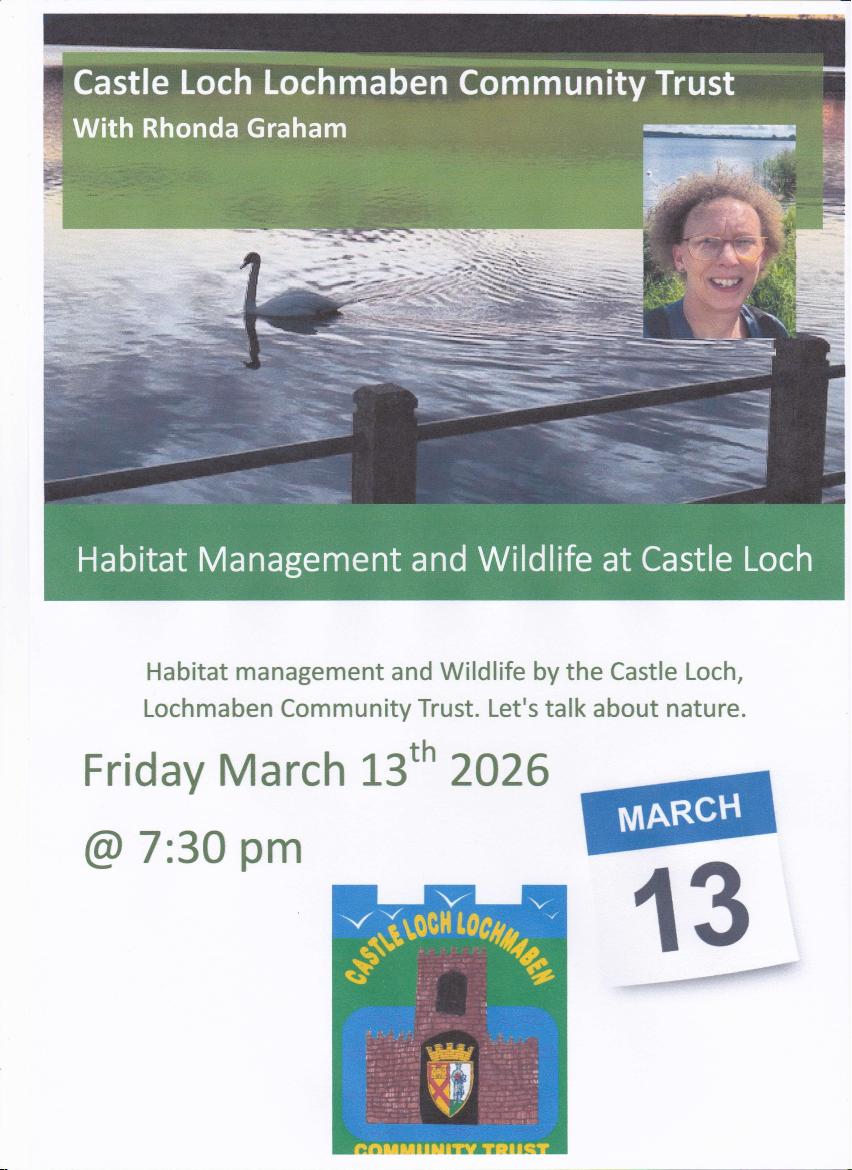
Dumfries and Galloway is renowned for its wildlife-rich wetland habitats, and one important site is Castle Loch, at Lochmaben. This important area is now managed by the Castle Loch Lochmaben Community Trust. The speaker, Rhonda Graham, is responsible for habitat maintenance at the site, and her talk focussed on how the site is managed.
Being close to Lochmaben, Castle Loch has to cater for a wide range of interests, from serious naturalists through fishing and sailing to sponsored walks and dog-walkers. An important part of her work is maintaining the 4-mile circular footpath around the loch, but many other activities are also involved. These include grass-cutting, which encourages grazing by wild geese, litter-picking, controlling or removing invasive species such as rhododendron, fringe water lily and Himalayan balsam, and managing woodland areas by thinning out or planting trees as appropriate. Clearly this is far more than one person can manage, and Rhonda is supported by an enthusiastic team of local volunteers.
The loch itself is rich in nutrients and attracts a wide variety of water birds such as ducks, grebes and cormorants, and the rare great white egret. These often rest up on Henderland Island, which is now designated as a bird reserve. The lake is also home to elusive otters.
A variety of habitats surround the loch. These include grassland, and coniferous and deciduous woodland. This last is home to one of Britain’s rarest song birds, the willow tit. A close relative of the familiar blue and great tit, its UK population has decreased by 96% since 1967, Castle Loch being one of the few remaining breeding sites in Scotland. It requires regenerating damp woodland with plenty of leaf litter and some dead and decaying trees, and maintaining this is an important part of the Trust’s work.
Maintaining a site such as Castle Loch requires not only time and effort, but also finance, and Rhonda has to spend a lot of time applying to funding bodies for grants. They have fortunately obtained grants from the National Lottery and the George Hunter Trust, among others, in recent years.
Rhonda’s enthusiasm for Castle Loch and the work of the trust shone through her lively talk, and provoked a number of questions from the audience. Clearly, the Loch is in good hands.