
George Hemstock, (Peatland Restoration Forester, Forestry and Land Scotland)
George Hemstock is currently a Peatland Restoration Forester with Forestry and Land Scotland, but his career actually started in mechanical engineering, spending five years building cars for Toyota. Driven by a passion for the outdoors, George completely pivoted his path. He started as a volunteer, became an award-winning park ranger in Nottinghamshire, and eventually moved to Dumfries and Galloway to tackle large-scale conservation projects, which included time as a Community Engagement Officer for the RSPB at Mersehead. While working full-time in peatland restoration, he recently earned his BSc in Forestry Management and is now researching the hydrological recovery of Longbridge Muir for his Honours dissertation.
Peatlands play a vital role in removing carbon from the atmosphere. The speaker pointed out that while peatlands only account for 3% of the world’s surface, they remove twice the amount of carbon absorbed by all the world’s forests. Dumfries and Galloway holds 20% of Scotland’s peatlands, and the Lochar Moss complex, just east of Dumfries, will, when fully restored, be one of the largest peat bog complexes in Western Europe.
Peat is essentially decomposing waterlogged vegetable matter, which not only absorbs carbon from the atmosphere, but also helps to retain water, and purify it through filtration. However, these properties have only been recognised comparatively recently, and prior to this peat bogs were thought to be useless unproductive land. Consequently large areas were drained and used primarily for planting commercial conifer forests. Indeed, the Government actually offered tax concessions to landowners for converting peatlands to forestry. Subsequent scientific research then showed that ploughing up peatland for forestry not only destroys its ability to absorb carbon, but results in a large emission of carbon as the anaerobic lower layers become oxygenated; it is thought that the amount of carbon released by ploughing up peatland is more than that emitted by all the cars in Scotland.
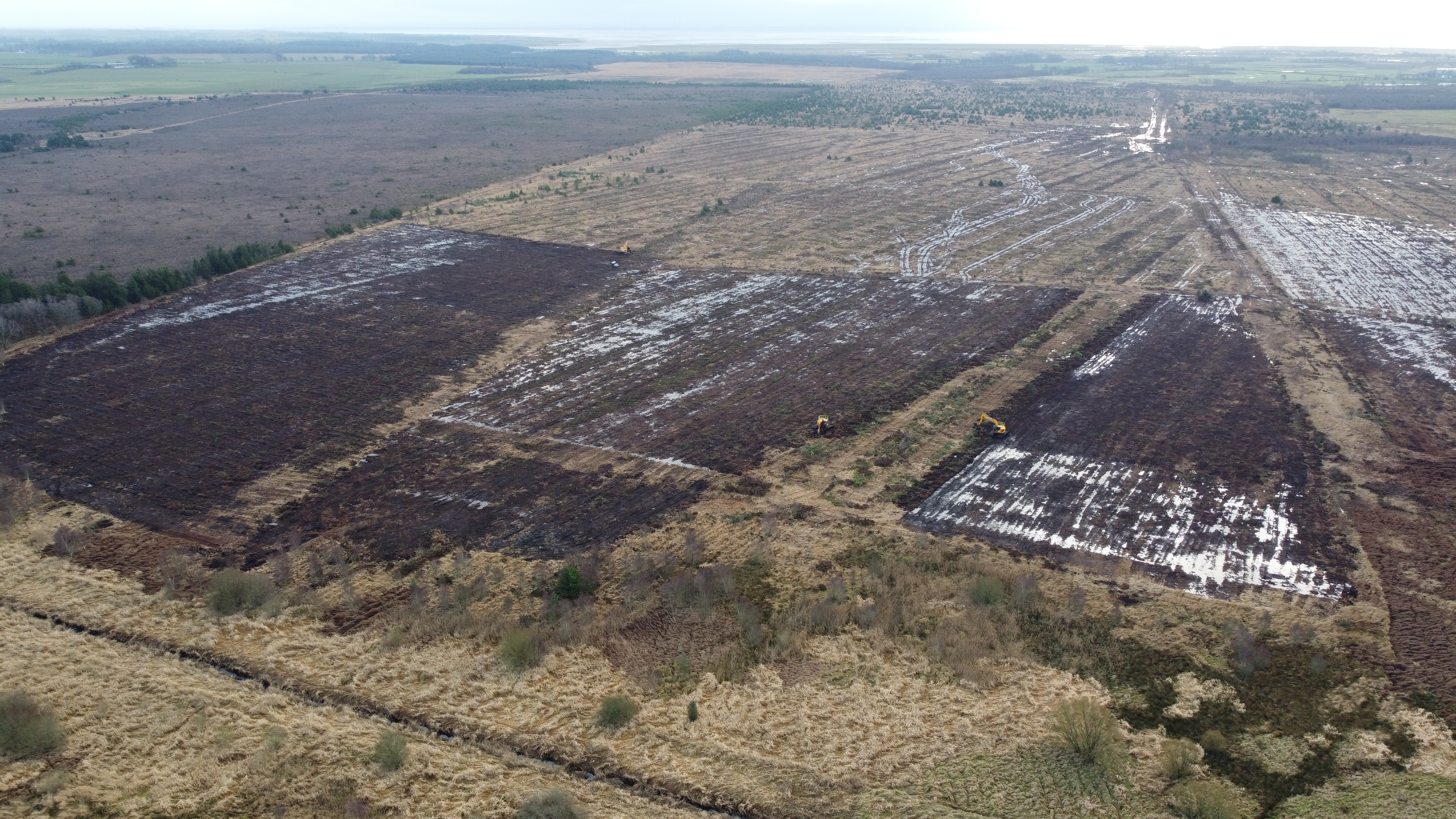
Although restoration of peatlands is now regarded as environmentally highly desirable, the process is complicated and expensive. The water table needs to be restored to its original level, and the correct flora, notably sphagnum moss and cotton grass, re-established (this may occur naturally once the raised water level is maintained). The speaker explained that firstly the trees needed to be removed, then the old drainage channels must be blocked, and peat bunds constructed to help retain water. Originally the stumps of felled trees were left in situ, but it was found that these caused the peat to leak water, and interfered with creating a level surface. The stumps therefore had to be dug up and inverted, roots uppermost, using special mechanical diggers with extra large tracks to prevent them from sinking into the ground. Detection and preservation of any remaining native flora and fauna is also required; the presence of adders was detected using specially trained adder-sniffing dogs! If all goes well, carbon storage can be restored in as little as 2 years, but the return of the full flora and fauna may take 20 years or more.
After a lively question and answer session, members continued discussions over tea and biscuits.